

Kaia Gao
Leanid Palhouski
Product explainer
—
Jan 7, 2026

AI search engines strongly favor content that is demonstrably current, accurate, and well-sourced. Wrodium’s claim-monitoring feature keeps factual statements continuously updated against verified sources, helping your pages avoid the steep visibility drop that affects stale content. The result is higher AI citation rates, stronger trust signals, and more qualified, AI-driven traffic.
Introduction
Content freshness has always mattered in search, but AI-driven discovery has raised the stakes. When users ask ChatGPT, Perplexity, or Google’s AI Overviews a question, those systems must decide which sources to trust and cite. Increasingly, recency is one of the strongest signals in that decision. Outdated facts reduce credibility, even if the rest of the page is well written.
For most organizations, keeping hundreds or thousands of pages current is difficult. Facts change quietly: funding rounds, regulations, pricing, policies, and benchmarks drift over time. Manual audits rarely scale. That gap between published content and current reality is where visibility is lost in generative search.
This article explains what AI search engines actually reward when it comes to freshness, how Wrodium’s claim-update feature works in practice, and the measurable impact of keeping facts continuously current. The focus is practical, evidence-based, and grounded in recent GEO research.
Core Concepts: Content Freshness in AI Search
Before examining Wrodium, it helps to clarify what “freshness” means in the context of AI search and Generative Engine Optimization (GEO).
What AI systems mean by “fresh” content
Content freshness is not only about publish dates. For AI systems, freshness combines several signals:
Recent factual accuracy: Claims align with the latest known data.
Visible updates: Pages show signs of maintenance, such as updated facts or modified timestamps.
Source recency: Citations point to current, reputable sources.
Large language models rely on retrieval systems to surface candidate documents. Those systems consistently rank newer or recently updated content higher, especially for commercial or factual queries.
GEO versus traditional SEO
Generative Engine Optimization focuses on being cited or summarized by AI answer engines, not just ranking as a blue link. In GEO, outdated content is rarely selected because models prioritize sources that reduce the risk of hallucination or error. Freshness becomes a trust filter, not a tie-breaker.
Key distinction:
Traditional SEO can tolerate some aging content if it still ranks. GEO cannot. Once facts are stale, AI systems often stop surfacing the page entirely.
How Wrodium’s Claim Update Feature Works
Wrodium approaches freshness at the level AI systems care about most: individual factual claims.
The claim-level approach
Instead of treating a page as static text, Wrodium treats it as a collection of verifiable assertions. A claim is any statement that could become outdated or incorrect over time, such as funding amounts, dates, regulatory status, or performance metrics.
Core workflow:
Claim detection and validation
Wrodium extracts factual assertions from your content and checks them against authoritative sources. These may include regulatory texts, contracts, internal databases, or reputable news feeds. This mirrors how retrieval-augmented generation (RAG) systems assess factual reliability.Suggested updates and review
When a claim conflicts with newer data, Wrodium flags it. Editors receive suggested corrections or approvals, ensuring human oversight remains central. For example, a funding claim from 2021 is updated when a 2023 round is detected.Source linking and provenance
Each verified claim is linked with metadata showing its source, publication date, and version history. This structured provenance acts as a machine-readable trust signal for AI systems.
Why this matters to AI retrieval
AI retrieval systems favor documents where facts are traceable and current. When claims are clearly sourced and recently validated, the content aligns with how LLMs reduce uncertainty during answer generation. In effect, Wrodium makes each page easier for AI systems to trust and reuse.
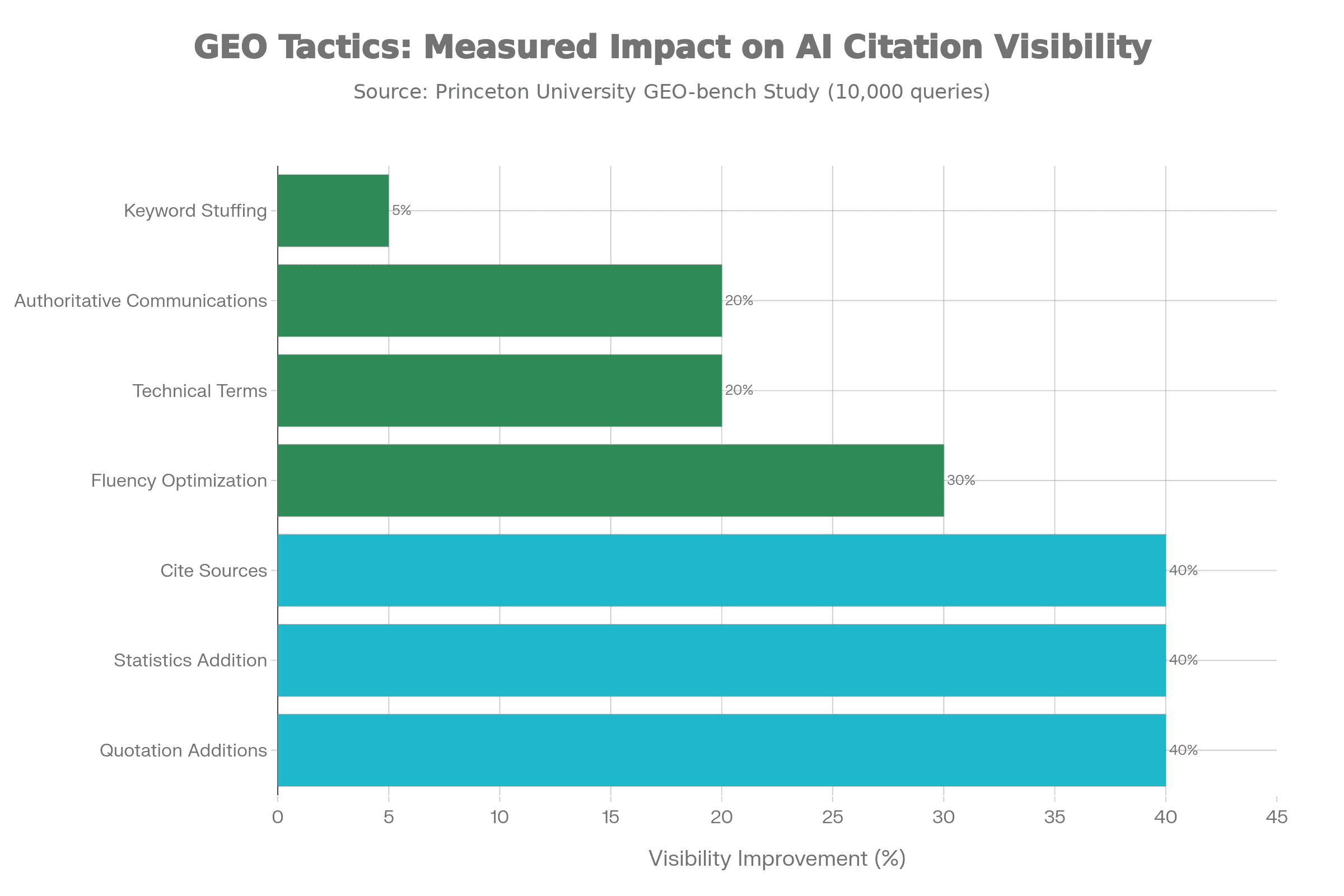
Empirical evidence from the Princeton GEO study demonstrates that adding quotations, statistics, and citations boosts AI visibility by up to 40%, while traditional SEO tactics like keyword stuffing show minimal impact
Why Freshness Matters for AI Search Visibility
Freshness is no longer a subtle ranking factor. It is a gating requirement for AI citation.
Evidence of a freshness bias
Multiple industry studies show a strong preference for recently updated pages in AI-generated answers. One widely cited analysis found that 83 percent of AI citations for commercial queries came from pages updated within the past year. Pages untouched for over 12 months saw their citation likelihood drop by more than 50 percent.
This pattern holds across platforms, including ChatGPT-style interfaces and AI-powered search overviews. Models prioritize sources that minimize the chance of outdated advice.
The “stale content penalty”
While not an official algorithmic penalty, the effect is real. Stale content becomes invisible in AI contexts. Even high-authority domains lose citations when their facts lag behind reality. For organizations relying on inbound leads or brand authority, this invisibility is costly.
Wrodium’s role:
By continuously refreshing claims, Wrodium keeps pages inside the “fresh” window that AI systems favor. Each update reinforces recency signals without requiring full rewrites.
Quantitative Impact of Continuous Freshness
The business case for freshness is supported by clear metrics from GEO research and case studies.
Key outcomes observed in the field
Avoiding citation loss
Pages not updated for over a year experience more than a 50 percent drop in AI citation frequency. Maintaining freshness effectively doubles citation opportunities compared with stale content.
Higher AI answer visibility
Academic and industry research shows that structured content updates can increase AI-generated answer visibility by roughly 30–40 percent. Some optimizations exceed 40 percent when freshness is combined with clear structure.
Traffic and lead growth
AI-referred visitors convert at significantly higher rates than traditional organic traffic. Case studies report conversion rates near 27 percent from AI-driven traffic, compared with about 2 percent from classic search. Organizations optimizing for GEO have reported double-digit gains in qualified leads within weeks.
Snapshot of freshness-driven metrics
Caption: Representative metrics illustrating the impact of content freshness on AI visibility.
Metric | Observed Effect |
|---|---|
AI citation share | ~83% from recently updated pages |
Citation drop for stale pages | >50% decrease after 12 months |
Visibility uplift | ~37% more AI answer mentions |
AI overview appearances | Up to 540% increase after refresh |
Sales-qualified leads | ~32% attributed to AI traffic |
These figures show why freshness is now a revenue driver, not just a content hygiene task.
Practical Checklist: Keeping Content Fresh with Wrodium
For teams evaluating whether automated freshness is worth adopting, the practical workflow matters.
A repeatable freshness process
Caption: Step-by-step checklist for maintaining AI-ready content freshness.
Step | Action | Outcome |
|---|---|---|
1 | Detect factual claims automatically | No manual audits |
2 | Validate claims against trusted sources | Higher accuracy |
3 | Review suggested updates | Editorial control |
4 | Publish claim-level updates | Continuous recency |
5 | Track citation and traffic changes | Measurable ROI |
This approach avoids full rewrites while keeping facts aligned with reality, which is precisely what AI systems reward.
Pros and Cons of Automated Claim Updating
Automation introduces clear benefits, but it also requires governance.
Caption: Balanced view of automated claim updating for AI search.
Pros | Cons |
|---|---|
Scales across large content libraries | Requires initial setup |
Reduces risk of outdated facts | Editors must review changes |
Improves AI trust signals | Not all claims are machine-verifiable |
Saves editorial time long term | Depends on source quality |
For most enterprises, the benefits outweigh the limitations, especially where AI visibility affects pipeline and revenue.
From the Field
From the Field:
In our own reviews of enterprise content libraries, we consistently found that 20–30 percent of factual claims were outdated within 18 months. Teams were surprised by how small changes, like updated benchmarks or revised policy language, immediately restored AI citations. The biggest shift was cultural: editors began treating content as a maintained asset, not a one-time deliverable. That mindset aligned far better with how AI systems actually consume information.
FAQs
Does freshness matter more than authority?
Both matter, but freshness often acts as a gate. Even authoritative sources lose AI visibility when facts are outdated. Authority without recency is rarely sufficient.
Are publish dates enough to signal freshness?
No. AI systems look at factual accuracy and updated claims, not just visible dates. Superficial date changes without content updates provide little benefit.
Can schema markup improve freshness signals?
Yes, structured data like dateModified can help retrieval systems detect updates, but it works best when paired with real factual changes.
Is automated updating safe for regulated industries?
Yes, when combined with human review. Wrodium is designed to surface suggested updates for editorial approval, preserving compliance and accountability.
Conclusion
AI search engines reward what reduces risk: accurate, current, and well-sourced information. Content freshness has moved from a best practice to a prerequisite for visibility in generative answers. Evidence from 2023–2026 shows that stale content quickly loses citations, traffic, and leads.
Wrodium’s automated claim verification and updating feature addresses this challenge at the level AI systems actually evaluate. By keeping individual facts aligned with the latest truth, it helps your content remain visible, trusted, and competitive in AI-driven discovery. The next step is simple: audit where factual drift exists and decide whether manual updates can realistically keep pace. For many teams, automation becomes the only sustainable path forward.
Updated January 7, 2026
References
Linkflow, “The Complete AI Visibility Score and Scorecard Framework,” Linkflow, 2024. https://linkflow.ai/blog/ai-visibility-score-and-scorecard-framework/
AIrops, “The Silent Pipeline Killer: How Stale Content Costs You AI Citations,” AIrops, 2025. https://www.airops.com/report/the-impact-of-stale-content-on-ai-visibility
Single Grain, “Real GEO Optimization Case Studies with Proven Results,” Single Grain, 2024. https://www.singlegrain.com/search-everywhere-optimization/real-geo-optimization-case-studies/
NVIDIA, “What Is Retrieval-Augmented Generation (RAG),” NVIDIA Blog, 2023. https://blogs.nvidia.com/blog/what-is-retrieval-augmented-generation/
Wikipedia, “Generative Engine Optimization,” Wikimedia Foundation, 2024. https://en.wikipedia.org/wiki/Generative_engine_optimization
Hill Web Creations, “Content Freshness: LLMs Favor Recent Info,” Hill Web Creations, 2024. https://www.hillwebcreations.com/content-freshness/
Walker Sands, “How Schema Markup Enhances LLM Visibility,” Walker Sands, 2024. https://www.walkersands.com/about/blog/how-can-schema-markup-support-llm-visibility/
Princeton Research, “GEO: Generative Engine Optimization,” arXiv, 2024.
https://arxiv.org/html/2311.09735v3

Product explainer
—
May 21, 2026
Top 8 AI Citation Tracking Tools in 2026
Kaia Gao
Leanid Palhouski
Product explainer
—
May 20, 2026
Knowledge Freshness Infrastructure vs. Traditional CMS: What Your CMS Can’t Do for AI Search
Kaia Gao
Leanid Palhouski

Product explainer
—
May 20, 2026
How to measure GEO ROI: Metrics that matter beyond citation count
Kaia Gao
Leanid Palhouski