

Arlen Kumar
and
Leanid Palhouski
Research paper
—
Oct 21, 2025
Abstract
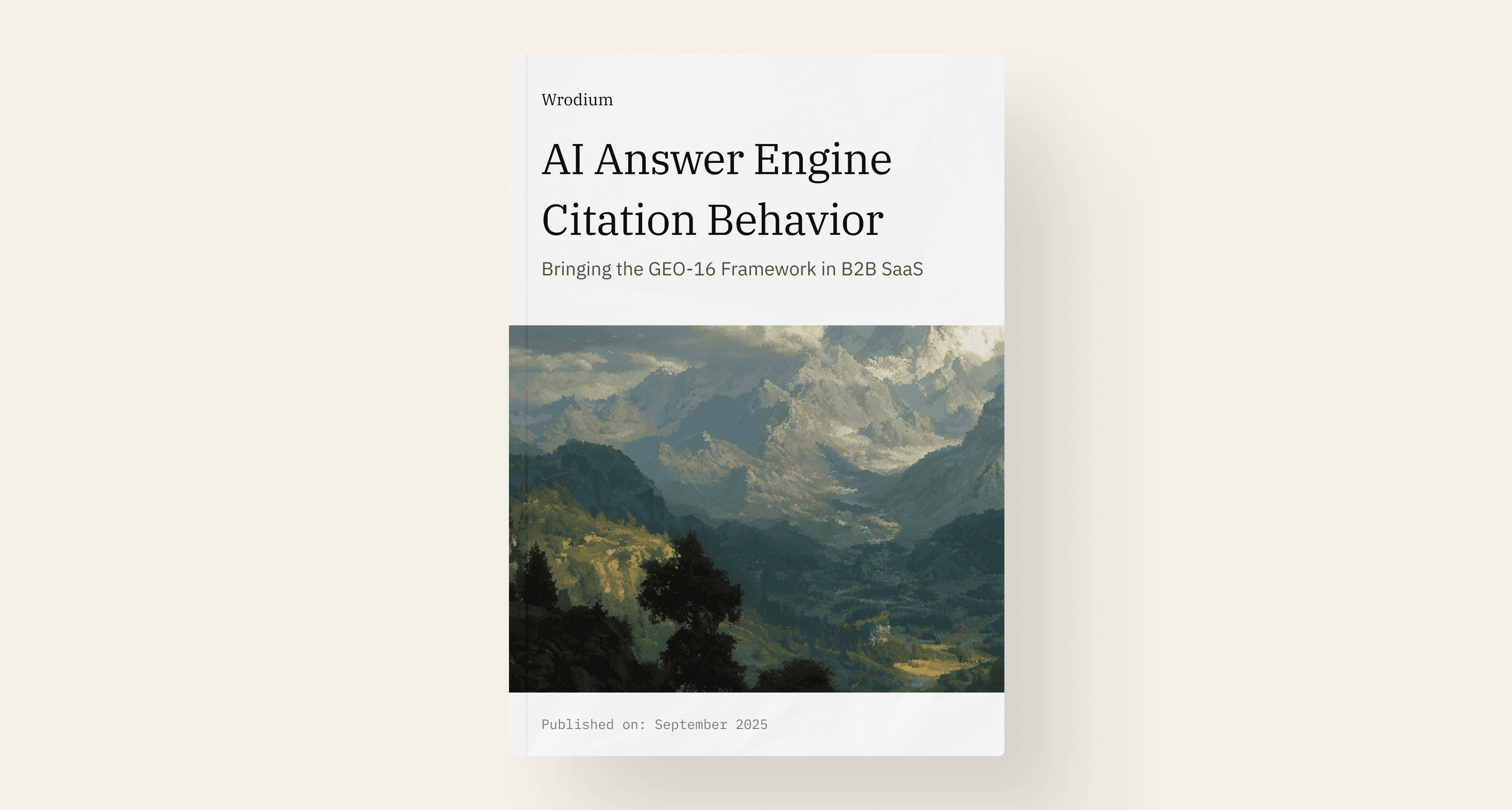
AI answer engines increasingly mediate access to domain knowledge by generating responses and citing web sources. We introduce GEO-16, a 16 pillar auditing framework that converts on page quality signals into banded pillar scores and a normalized GEO score G that ranges from 0 to 1. Using 70 product intent prompts, we collected 1,702 citations across three engines (Brave Summary, Google AI Overviews, and Perplexity) and audited 1,100 unique URLs.
In our corpus, the engines differed in the GEO quality of the pages they cited, and pillars related to Metadata and Freshness, Semantic HTML, and Structured Data showed the strongest associations with citation. Logistic models with domain clustered standard errors indicate that overall page quality is a strong predictor of citation, and simple operating points (for example, G at least 0.70 combined with at least 12 pillar hits) align with substantially higher citation rates in our data.
Explore our complete study, data, and findings behind this article.

Product explainer
—
May 21, 2026
Top 8 AI Citation Tracking Tools in 2026

Kaia Gao
Leanid Palhouski
Product explainer
—
May 20, 2026
Knowledge Freshness Infrastructure vs. Traditional CMS: What Your CMS Can’t Do for AI Search
Kaia Gao
Leanid Palhouski

Product explainer
—
May 20, 2026
How to measure GEO ROI: Metrics that matter beyond citation count
Kaia Gao
Leanid Palhouski