

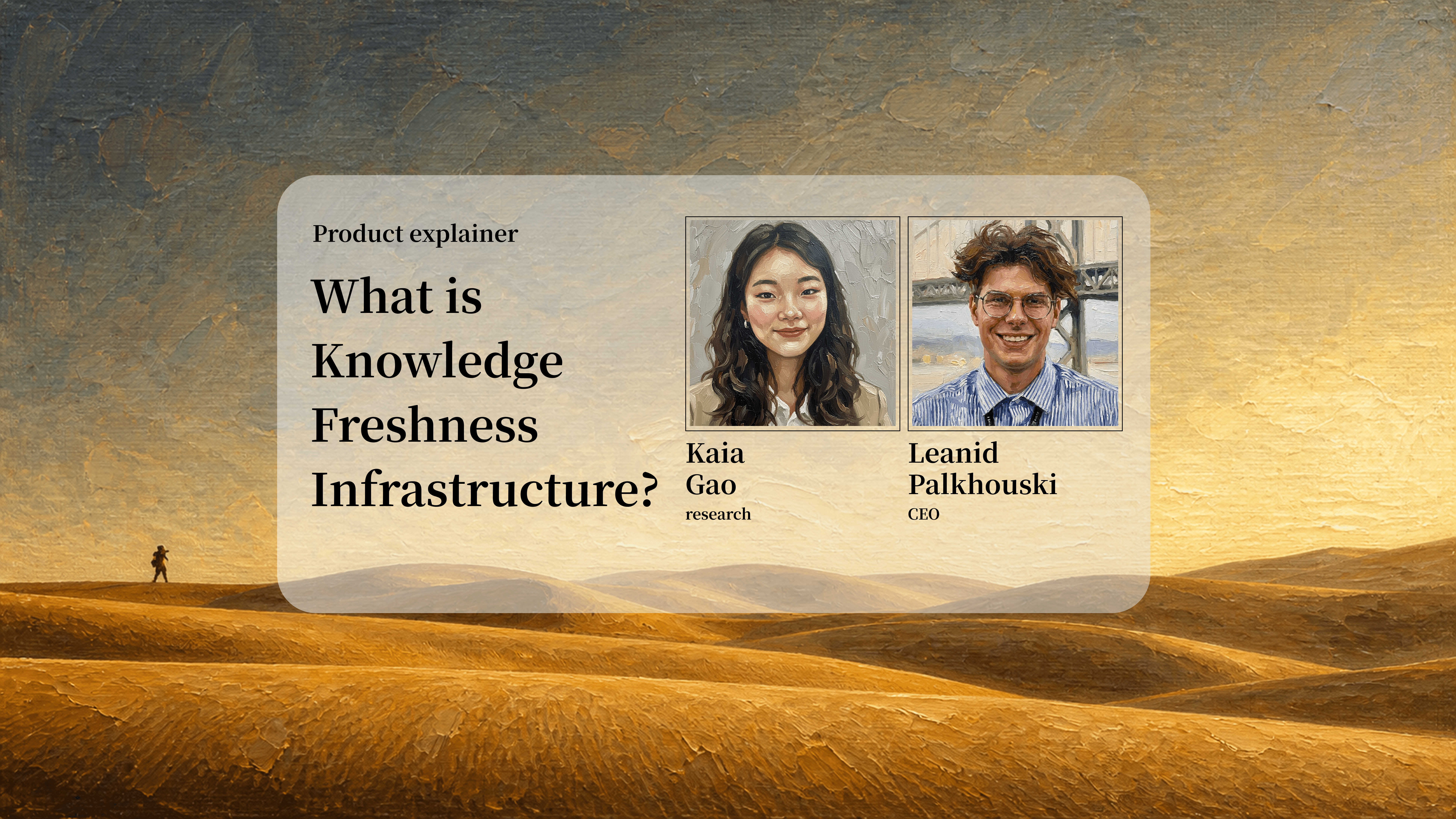
Kaia Gao
Leanid Palhouski
Product explainer
—
May 1, 2026

Knowledge Management (KM) helps you capture, organize, and retrieve information. Knowledge Freshness Infrastructure (KFI) helps you keep factual claims accurate, consistent, and verifiable as reality changes. In 2026, AI-driven answers raise the cost of outdated content, so “findable” is no longer enough.
Introduction
The failure mode has shifted from missing knowledge to stale knowledge
Enterprises have spent years improving KM with wikis, intranets, and search. The bigger risk now is not failing to find a page, but finding a page where the facts are outdated.
AI makes stale facts travel faster
AI search and copilots increasingly summarize and synthesize content instead of just ranking links. If your ecosystem contains conflicting versions of a policy, an AI layer can blend them into one confident-sounding, incorrect answer.
Knowledge Management (KM), defined
KM is the practice and tooling that helps you capture, organize, and retrieve knowledge as content objects (documents, FAQs, runbooks). Reviews typically happen on a schedule, and updates are manual.
Knowledge Freshness Infrastructure (KFI), defined
KFI is an operational layer that treats knowledge as claims. A claim is a discrete factual assertion (e.g., "Eligibility is 18+"). KFI focuses on drift detection, verification against sources of truth, and synchronization across all channels.
KM and KFI solve different problems
Dimension | Knowledge Management (KM) | Knowledge Freshness Infrastructure (KFI) |
Primary Unit | Document or page | Factual claim (structured/versioned) |
Primary Goal | Find and reuse knowledge | Keep claims accurate over time |
Workflow | Publish, then periodic review | Monitor, verify, then propagate |
Main Risk | Poor search relevance | Drift, contradictions, compliance risk |
AI Question | “Can the copilot find it?” | “Can an AI trust and cite it?” |
Why Freshness Matters More in 2026
1. Provenance is the New Currency
AI systems reward content with clear provenance—the recorded origin of a claim. In 2026, being able to prove when a fact was verified and by whom is a primary trust signal for both search engines and users.
2. The "Policy Split-Brain" Problem
Modern content chains publish the same facts across apps, help centers, and websites. Without KFI, you risk "policy split-brain," where two official pages disagree because one updated and the other did not.
Practical Comparison: When KM is Enough vs. When You Need KFI
Quick Fit Assessment by Content Profile
Content Profile | KM Alone | KFI Value |
Stable Reference (Glossaries, Concepts) | High | Medium |
Operational Procedures (Runbooks) | Medium | Medium |
High-Change Facts (Pricing, Eligibility) | Low | High |
Regulated Disclosures (Legal, Safety) | Low | High |
How to Build KFI (Without Rebuilding Everything)
Identify “High-Friction Facts”: Start with pricing, eligibility, SLAs, and legal disclosures.
Define Sources of Truth: Link every claim type to a system of record (e.g., a product database or legal template).
Implement Verification Cadence: Assign a business owner to verify the claim at set intervals (weekly, monthly).
Make Freshness Legible: Add "Last Verified" dates and canonical metadata so both humans and AI bots can see the "freshness" of the data.
FAQs
What problem does KFI solve that KM does not?
KM finds the library book; KFI makes sure the statistics inside the book haven't expired since it was printed.
Do I need a knowledge graph to implement KFI?
No. While helpful, you can start with a simple claim registry (a database or structured list) and verification workflows.
How does KFI relate to AI search?
AI search engines cite specific facts. If those facts are consistent and fresh across your ecosystem, the AI is more likely to provide a reliable answer rather than a hallucination or an outdated summary.
Conclusion and Next Step
KM helps you build a library; KFI helps you keep the truth layer accurate as reality changes. In 2026, "findable" is no longer enough—knowledge must be verifiable.
Next step: Pick one high-change domain (like Pricing), inventory where those claims appear, and assign a single "Source of Truth" for that domain. Ensure all surfaces pull from that source before scaling to other areas.
Updated: 2026-05-01
References
Google Search Central, “AI Overviews and Search,” 2024.
Harvard Law Review, “Addressing the Problem of Link and Reference Rot,” 2014.
SEC, “Marketing Rule FAQ,” 2024.

Product explainer
—
May 4, 2026
Best Knowledge Freshness Infrastructure Tools in 2026
Kaia Gao
Leanid Palhouski
Product explainer
—
May 3, 2026
Knowledge Freshness Infrastructure (KFI): Definition, Components, and How to Implement It
Kaia Gao
Leanid Palhouski

Product explainer
—
May 2, 2026
Knowledge Freshness Infrastructure vs. RAG: Why Retrieval Is Not “Truth Over Time”
Kaia Gao
Leanid Palhouski